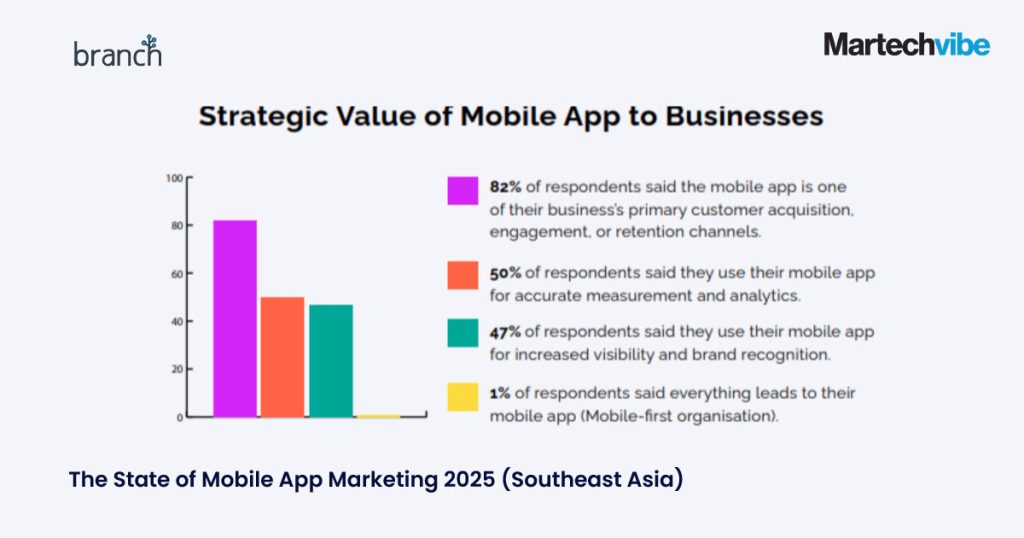
Marketers spend a hefty amount of their budgets on their mobile apps. In fact, according to research, the mobile app is one of the primary customer acquisition, engagement, or retention channels for 82% of marketers. However, it is disappointing that this application remains underutilised and fails to reach its full potential.
How can one identify if their business is completely utilising their mobile’s app functionality? A quick browsing of expert literature on the topic will tell you that the way to do this is by ensuring that it is meeting the customers’ needs. This can be evaluated by analysing customer data, reviewing customer feedback, studying insights from customer support, and assessing for further need for personalisation.
More and more businesses are realising the significance of running a well-oiled mobile app that acts as the perfect medium between the business and its customers. However, as marketers juggle between the varied aspects of a mobile app, they often lose track of many crucial elements.
A study conducted by Branch and Martechvibe revealed that there are three stages of the app marketing cycle that if run the right way, can ensure seamless utilisation of the mobile app.
The State of Mobile App Marketing 2025 (Southeast Asia) defines the three A’s of mobile app marketing journey as follows;
Amplifying awareness is the first stage where you create a “buzz” about your business through your app. It is when users find out about your app and your brand visibility and recognition come into play.
This stage is a crucial foundation for success in the competitive app landscape. According to the Branch report, 47% of marketers use their business’ mobile app to increase visibility and brand recognition.
Awareness is also the first stage of the user journey. As customers start to gain knowledge of the brand’s existence, it is crucial not to lose sight of what is key.
In the second stage, the focus is on accelerating acquisition. Once customers have shown an interest in the brand during the first phase of awareness, the aim is to convert that interest into app downloads and add active users to the brand’s audience.
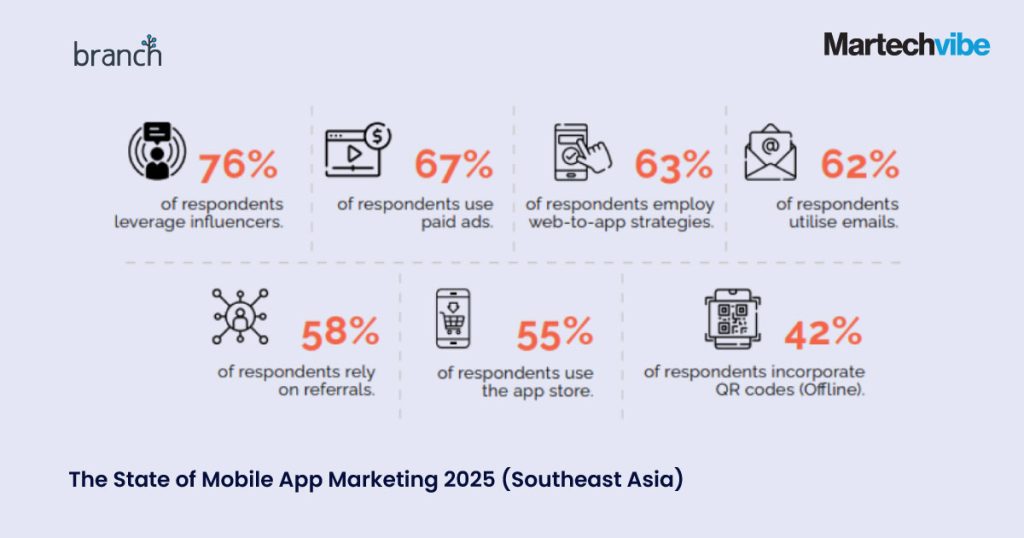
in their overall strategy as more than 5, on a scale of 1 to 10. As per the report, here is how businesses are currently acquiring new app users:
“Web users may perceive downloading and using an app as an extra step. Addressing app permissions, data privacy, and security concerns is crucial to gaining user trust and overcoming hesitations. Offering exclusive features, enhanced personalisation, and a seamless user interface within the app can incentivise web users to make the switch. Additionally, effective communication highlighting the app’s advantages, such as real-time notifications, personalised recommendations, and faster transactions, can encourage web users to embrace app adoption,” adds Parahita.
The third stage centres around achieving activation through engagement. Here, the focus shifts to engaging users through exceptional experiences, encouraging frequent usage, and driving meaningful interactions within the app. Success in this stage leads to increased user retention and long-term loyalty.
When it comes to app adoption, marketers must strive to offer a sticky app experience, for which, both pre- and post-purchase phases are equally important, explains Khalate.
“Engagement is key. Many platforms now offer interactive content like games, allowing users to earn loyalty or cashback points, which can be used in future transactions. These strategies all contribute to improving app stickiness,” she adds.
Research shows that app adoption still hasn’t reached its maximum for many brands. According to the Branch report, only 12% of businesses have successfully reached the critical stage where 75-100% of their customer base are active users.
Doing so requires understanding your users better,” says Niharika Gupta, Head of Consumer and Loyalty Marketing at Adidas Southeast Asia. Gupta suggests asking yourself these four questions about your customers:
For ultimate app success, marketers must implement a strategy that only acquires new users but re-activates idle customers with re-engagement. Branch’s State of Mobile App Marketing 2025 (Southeast Asia) suggests the following shifts to guide dormant users back with a necessary pivot:
“As you look to the future, embracing data-driven strategies and leveraging advanced technologies will be key to achieving sustained growth and success,” he adds.
The State of Mobile App Marketing 2025 (Southeast Asia) report offers an insider’s view into outlooks, actions, and readiness for mobile app growth success. Read the full report here.
Register here for Unlocked: Mobile & App Growth Summit Singapore.

Vibha Thusu is a seasoned marketing and communications leader with over 21 years of experience at the intersection of technology, brand strategy, and business growth. She has worked across diverse industries including IT & Services, FMCG, Energy Management, Electrical, & Industrial Automation. She currently serves as the Global Marketing & Communications Program Leader (Industrial Automation E-commerce) at Schneider Electric, where she drives strategic communications, demand generation, and cohesive internal engagement across IA Distribution & eCommerce Lines of Business. A Schneider Electric veteran of 16 years, she previously led global marketing, communications, and e-commerce for an independent brand under the SE umbrella, accelerating market expansion and brand equity across more than 65 countries.

Suad Merchant is the Global Chief Marketing Officer (CMO) at GEMS Education, where she leads global marketing, brand strategy, and communications. In this role, she reinforces GEMS Education’s reputation as a trusted, family-run institution delivering world-class education with heart and vision. Her mandate goes beyond communications, she is a key driver of business growth and impact, ensuring GEMS continues to lead in a sector critical to regional and global development.
Previously, Suad was the Global Head of Brand & Growth Marketing, Partnerships, and Corporate Communications at Mashreq, the UAE’s oldest bank with a presence in 15 countries. She defined and executed the bank’s global brand and marketing strategy, corporate communications, strategic partnerships, and ESG marketing. Suad also played a pivotal role in shaping Mashreq’s strategic vision, acting as brand custodian, and steering its customer-centric digital transformation. Under her leadership, Mashreq was recognized as the fastest-growing brand in the Middle East by Brand Finance in 2024.

Ravi Raman, a TEDx speaker and no stranger to a stage, is a media professional with more than two decades of content strategy, brand marketing and team leadership experience.
He launched the regional editions of world-renowned brands such as Wired and Bloomberg Businessweek, and his reach has extended to other leading publications from the New York Times to India Today.

Hazem graduated with a Bachelor of Science in Computer Science from The American University in Cairo in 2002. Since then, he has developed a passion for and built a career in connecting the business world with technology.
He has led projects across all areas of the digital mix including web platforms, mobile solutions, social media, content, performance marketing, search engine optimization and marketing, paid digital advertising and programmatic, data and analytics, CRM, and ecommerce… making him not only an advocate but also a hands-on practitioner of omni channel marketing. He has been a consultant to many brands, defining and implementing their digital transformation strategies, and implementing complex MarTech solutions to influence data-driven customer engagement comms throughout their lifecycle.

Harsha is a seasoned marketing professional with over 18 years of experience in global digital and traditional media marketing.
She has left a lasting impact on consulting, professional services, travel, and consumer products sectors. Notably, she established PwC’s digital marketing practice in the Middle East and led digital marketing for UAE’s cybersecurity firm DarkMatter (now Digital14).
Currently, at KPMG Lower Gulf, Harsha is driving the transformation of the firm’s digital marketing and enhancing customer experiences, showcasing her enduring commitment to innovation and excellence in the field.i and is the founder of WOA (Work Of Arts), a boutique consultancy and concept studio. He also supports early-stage ventures and owns hospitality businesses in Asia.

Aamir Allibhoy is the General Manager at SRMG | Labs, leading innovation and strategic growth initiatives within one of the region’s most influential media groups.
Aamir’s career spans more than two decades across marketing, creativity, and brand transformation. Prior to joining SRMG, he spent 21 years with Impact BBDO, where he served as General Manager for Saudi Arabia and worked with leading global brands including PepsiCo, Emirates, P&G, YUM, and others. He also played a key role in establishing the award-winning BBDO Pakistan office.

Gregoire is a senior innovation and customer experience leader with more than 20 years of experience transforming major organisations across Retail, Luxury, Government, Real Estate, Hospitality, and Mobility. Most recently, Group VP of Customer Experience & Innovation at Majid Al Futtaim, his career also includes senior roles at Chalhoub Group, Emaar, Air Liquide, Rexel, and Orange.
An entrepreneur and investor, he co-founded the European mobility startup Otoqi and is the founder of WOA (Work Of Arts), a boutique consultancy and concept studio. He also supports early-stage ventures and owns hospitality businesses in Asia.